Keeping Research Quality High When More Teams Run Their Own Studies
Learn the guardrails that keep research quality high when non-researchers run studies: scoping tiers, review gates, a shared repository, ownership and KPIs.

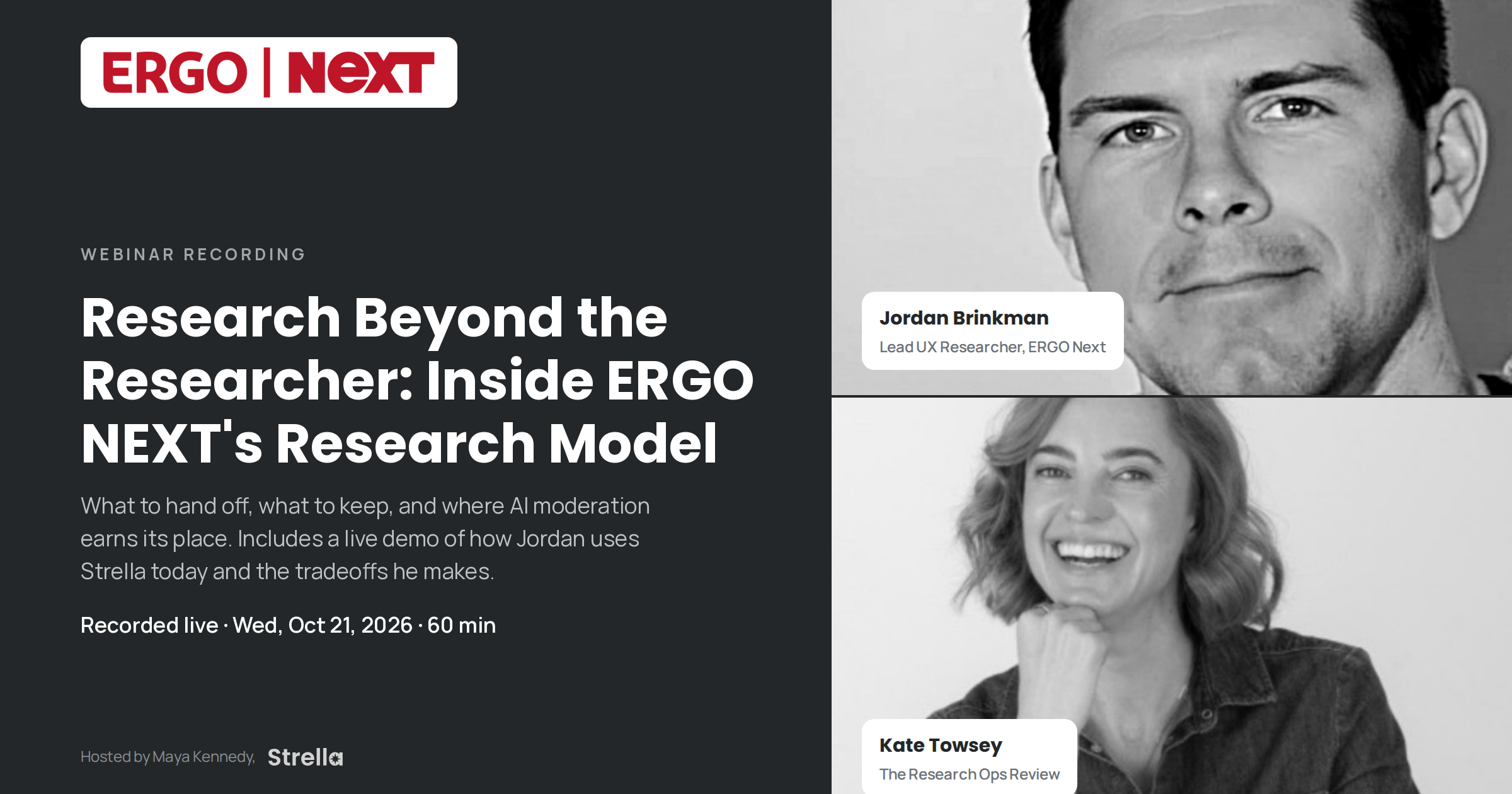
Brand, marketing and product teams at consumer companies already run their own studies; the insights team stopped being the only place research happens some time ago. The insights leader’s job shifts from running every study to keeping quality high without turning the team into the queue everyone waits in. Strella’s webinar “Research Beyond the Researcher: Inside ERGO NEXT’s Research Model” shows one lean research team doing exactly this, and the recording is available to watch here.
What are research guardrails and why do they matter?
Research guardrails are the rules, review gates and limits that let people outside the insights team run a study without producing a finding the business cannot trust. Nielsen Norman Group puts it bluntly: “Governance guidelines are a necessity for any study involving participants.” In practice the guardrails fall into five kinds:
- Scoping: who can run which kind of study, tiered by what the decision costs if the research is wrong.
- Templates: validated discussion guides and screeners that carry a researcher’s judgment into studies the researcher never touches.
- Review gates: a pre-launch check on the research question, the screener, the guide and the consent language.
- Privacy rules: consent, recording, retention and deletion rules that apply to every study regardless of who runs it.
- Oversight: a named owner with hours in the week to review, coach and escalate.
Without them, the same four errors recur: leading questions, confirmation bias in reading transcripts, convenience sampling, and cherry-picked quotes in the deck.
Wording alone shifts answers more than most non-researchers expect. In a Pew Research Center wording experiment, asking about “good jobs” rather than “jobs” moved the result from 60% to 48%. Guardrails turn a researcher’s judgment calls into steps a product or marketing lead can follow.
Who can run what, by decision stakes?
Tier access by what the decision costs if the research is wrong. GitLab’s public handbook runs three tiers, from researcher-owned foundational work to a consult tier. That split between what product managers and designers run and what stays researcher-led is the core topic of Strella’s ERGO NEXT webinar recording.
For a consumer insights team, a proposed stakes-based matrix maps tiers onto the decisions the business makes:
What templates and pre-launch review gates should be in place?
A validated template is a ready-made discussion guide in which a researcher has separated the research question from the interview questions. It favors recall of past behavior over hypotheticals, keeps each question to one concept and supplies neutral probes.
The review gate then checks what the template cannot. Under the proposed tiers, the brand or product lead self-approves tactical studies from the template. A researcher approves directional studies. Strategic or sensitive work goes to the insights lead plus legal for approval. The pre-launch checklist covers:
- Research question: one primary question and the named decision it serves. Record its tier.
- Screener: favor past behavior over hypothetical use and avoid yes/no questions that give the study away. Review both qualified and disqualified responses before confirming participants.
- Guide: trace every question to the research question and flag leading wording. Run a pilot with a colleague.
- Consent and recording: plain-language consent that states the purpose and how recordings are used. State that participation is voluntary and confirm recording consent at the session start.
- Privacy and retention: state a retention period and a deletion route. Anonymize data before anything leaves the research team.
Privacy requirements. The 2025 ICC/ESOMAR International Code requires telling participants how long their data is kept and honoring withdrawal with deletion where feasible. Researchers must also anonymize or delete data once they no longer need it.
The Code also requires disclosing AI use and the extent of human oversight to clients, which applies to every AI-moderated study a non-researcher launches.
Platform checks. Platforms can carry part of the gate. On Strella, where an AI moderator holds the interviews with participants, a marketing lead enters the study objectives and gets a drafted discussion guide back, with leading or biased questions flagged before launch and every line editable.
The screener fact-checks verifiable claims and drops participants who make false ones. Neither step guarantees an unbiased study; both catch the errors a first-time guide writer is least likely to see.
If a self-serve study fails the gate twice, it moves up a tier.
Why does a shared repository count as a guardrail?
Duplicate and conflicting studies are the quietest quality failure when more teams run research, because nobody notices until two teams present conflicting conclusions in the same leadership meeting. That can happen when:
- A marketing lead runs a messaging study without knowing brand ran one on the same audience last spring.
- A product team tests a feature’s value proposition and reaches the opposite conclusion from a pricing study still sitting in someone’s slides.
Teams can prevent both by assigning a repository owner and checking past work: NN/g’s July 2024 repository survey of more than 400 UX and ReOps professionals found 29% of repositories had no owner, and adoption was rated good or better for 65% of repositories older than three years against 34% of those under a year old.
The guardrail works when asking the repository is faster than commissioning a study. That means every past study, agency deck and customer call in one place, queryable in plain language rather than by folder name, with each answer pointing back to the transcript it came from. The Strella repository accepts historical interviews, customer calls and research documents alongside new AI-moderated studies.
A strategy lead can ask what subscribers said about price across the last two years and get an answer linked to the source interviews, with video where it exists. If the team can answer the question from the repository, it does not launch a new study.
Where does AI moderation make self-serve studies more consistent, and where does it stop?
An AI-moderated interview is a voice-to-voice conversation in which a real person talks with an AI moderator that follows a researcher’s discussion guide and asks relevant follow-up questions. It is its own methodology, sitting between a survey and a human-moderated in-depth interview, and that position makes it a consistency guardrail for self-serve qualitative research. A survey asks the same questions but cannot follow up. A human-moderated interview follows up, but five moderators across a study probe five different ways. An AI moderator works from one reviewed guide and applies the same probing logic to every participant. Researchers can bias-check it before anyone talks to a consumer.
In a Quirk’s comparison published in August 2026, 34 online interviews showed AI transcripts to be highly consistent while five human moderators varied. Human moderation drew more detailed, personal responses where cultural nuance and emotional weight were high. Because each method has its own strengths, teams are choosing a methodology when they pick a moderator, and human moderation is the method to choose at scoping for work involving trauma, vulnerability, crisis or deep cultural meaning.
Strella runs live human-moderated interviews in the same platform as AI-moderated ones, so a team does not switch tools to make that choice. On Strella the AI moderator holds a live voice-to-voice conversation with a real participant and adapts its follow-up questions to what the participant says. When the interviews finish, Strella synthesizes results by objective and links every theme to the verbatim and video behind it.
That traceability is the second half of the guardrail: a non-researcher cannot cite a finding without the interview it came from. To hear how the moderator follows up on an answer, try an interview.
When a study needs identical questions across dozens or hundreds of people, a team should use AI moderation; when it needs someone to read the room, the team should assign a human moderator at scoping.
Who owns the guardrails? The role of research ops
Guardrails need an owner with hours in the week to review and coach, plus time to handle escalations. Kate Towsey, author of Research That Scales, puts it this way in an interview: “research itself doesn’t scale, systems do.”
A charter makes the ownership explicit. A workable outline runs:
- Purpose: what research the company runs and what the insights team is accountable for.
- Who runs what: the three-tier matrix, with named approvers per tier.
- Templates and gates: which templates are validated and who maintains them. Include the pre-launch checklist.
- Privacy and consent: consent forms by context, retention periods, anonymization and the deletion route.
- Review workflow: turnaround commitment for researcher review, and what research ops spot-checks.
- Escalation: triggers that move a study up a tier, including sensitive topics, children or vulnerable participants, identifiable health or financial data, and new audiences.
- Repository: who owns it and the expectation that studies are checked against it before launch.
For a brand without an in-house researcher, the charter still works; the strategic tier routes to outside hands. Strella’s research team can scope a study, recruit participants, run the AI-moderated interviews and synthesize the results through the platform’s fully managed service level. Daily Harvest used Strella to validate its DTC reinvention.
If no one has review hours budgeted, the directional and tactical tiers stay closed.
How does a team measure whether the guardrails work?
Measure the gates and the rework they prevent. Track which decisions the research changed. Towsey cautions that metrics become useful only after six months to a year of consistent tracking. Track these six:
- Review pass rate: the share of self-serve studies that clear the pre-launch gate on the first pass, tracked by tier and by team.
- Rework rate: studies teams re-run because the screener recruited the wrong people or the guide led participants. Include re-runs due to incomplete consent.
- Repository reuse: the share of requests answered from existing evidence without a new study, the metric Jess Waldschmidt recommends in Quirk’s as “percent resolved from existing assets.”
- Researcher time mix: share of researcher hours on strategic work versus reviewing or rescuing tactical studies.
- Decision impact: NN/g’s Recommendation-Adoption Score weights each recommendation and scores adoption over a rolling 12-month window. Its result bands run from Poor (0 to 29) to Great (80 to 100).
- Turnaround: days from request to a finding leadership can act on, by tier.
Watch the recording: inside ERGO NEXT’s research model
Strella’s webinar “Research Beyond the Researcher: Inside ERGO NEXT’s Research Model” features Jordan Brinkman, the sole UX researcher at ERGO NEXT, an insurance technology company of roughly 700 to 800 people, where he supports product, marketing, partnerships and every business unit. His starting rule is that research should never be the blocker, and the model he describes follows from it:
- Gradual release. A former teacher, Brinkman coaches the way teachers are trained: the first study a PM or designer runs, he is involved from setup through analysis; by the second he steps back from setup, by the third from analysis, and by the fourth he reviews only before launch.
- A method test, not a rulebook. He weighs complexity, risk, unknowns and urgency. A focused question such as how insurance agents use AI in their day-to-day work fits a 10 to 15 minute AI-moderated interview; a nuanced workflow question such as how agents choose a carrier stays human-moderated.
- Objectives first, then the tool. Anyone can get creator access after one meeting to set objectives. He advises on method, the requester builds the study in Strella, and he coaches on guide design, recruitment and analysis. Most studies launch in one to three days and never more than a week.
- QA before launch. The study owner runs two pilots on themselves, Brinkman runs through it, then one or two real users pilot it before full launch. Dynamic follow-ups start on low and always follow a multiple-choice question.
- Everyone watches the videos. The AI is a note taker; the researcher and the study owner still watch every session before synthesis, and Brinkman reviews a non-researcher’s first findings with them, including which clips they chose and why.
- Research embedded in product development. AI-moderated interviews now run alongside A/B tests on beta and experiment groups, seven or eight times in the last six months, so qualitative feedback lands next to the data science readout.
Kate Towsey, author of Research That Scales and editor-in-chief of The ResearchOps Review, adds a crawl, walk, run path: start with the smallest useful step rather than the fully automated workflow, and decide first which of the organization’s top priorities AI should augment, automate or leave fully human.
FAQ
How does an insights team know it is ready to let other teams run their own studies?
A team is ready when it has a validated template and a named reviewer with time to review. It also needs a repository the new teams can check first; readiness depends on those systems being in place. The practical test is whether a marketing lead can launch a tactical study without a researcher touching it and the insights lead can still trace every finding to a participant.
How does self-serve research differ from opening up data access?
Self-serve research is a way of working in which people outside the insights team run their own studies and generate new primary evidence, whereas opening up data access lets them analyze data that already exists, so the guardrails differ. Teams opening up data access need to govern definitions and sources so people do not misinterpret existing data. Teams running self-serve research must prevent methodological error and participant harm, which is why they need scoping tiers, templates, review gates and consent rules rather than access permissions alone.
Do AI research tools make self-serve studies safer or riskier?
Both, and the deciding factor is whether a researcher still reviews the work. AI tools draft guides, flag leading questions, run consistent interviews and synthesize with source links, which removes the errors first-time researchers make most. The risk is teams sharing polished output without review: a Quirk’s May 2026 article reported 47% of respondents saying AI-generated insights reach senior leaders with zero researcher review, though the survey base is not shown, so insights leaders should require review and traceable evidence behind each finding.
What goes into a quality gate before a study launches?
A quality gate checks four things: the research question names the decision it serves, the screener recruits on past behavior, the guide has no leading or double-barrelled questions and has been piloted, and consent, recording and retention language meets the applicable code and law. The approver changes by tier, from the brand or product lead self-approving a template for tactical work to the insights lead and legal for strategic or sensitive studies.
Need to work out which studies to hand to other teams and which to keep? See Strella in action.