How Daily Harvest used Strella to validate a complete DTC reinvention
With no in-house research team and an ambitious mandate to reinvent its direct-to-consumer business, Daily Harvest turned to Strella's AI-moderated research to validate key decisions along the way, from strategy to usability.


Daily Harvest has been around for over a decade. As pioneers of the DTC subscription model, they helped turn smoothies-by-mail into a mainstream concept. But by 2025, the model they helped invent had become commonplace, and the business found itself at a crossroads.
In the middle of 2025, leadership issued a mandate: find genuinely new ways to grow, even if it meant throwing the existing business model on its head. The brief came with very few guardrails and a long list of hypotheses to test.
The Challenge
Jackson Mlawer leads product and technology at Daily Harvest. His team is responsible for delivering a seamless, elegant customer experience. They're a small group, with no in-house researcher and no appetite for the kind of long, expensive research project the reinvention seemed to call for.
But the team had real hypotheses about who their target customer was, why growth had stalled, and what kinds of products might unlock the next chapter. The team was ready to test with real customers using high-level concepts they wanted to pit against each other before committing engineering and supply chain to any of them.
As they thought about how to validate those hypotheses, three avenues came into focus.
The first was the traditional research path: large-scale surveys plus moderated qualitative interviews, run through an outside agency. From a budget and timeline perspective, that route was a non-starter. And surveys alone wouldn't capture the depth they needed; the team wasn't just trying to measure preference, they were trying to understand why a customer would buy a specific product, how it would fit into a daily routine, what they'd be willing to pay, and whether they'd come back. Those answers only come out of an actual conversation.
The second avenue was to do nothing: to act on instinct and hope for the best. As Jackson put it, that's effectively how the business had been operating for a long time, and the team knew its limits.
The third avenue was a modern, AI-moderated research alternative: Strella.
The Process: Three Acts of a Reinvention
Daily Harvest didn't run a single study with Strella. They ran a sequence of studies, and each one expanded what research could do for the business. The arc maps cleanly to the reinvention itself: first a strategic question, then an experiential one, and then a question of design.
Act 1 — Strategy: Finding the "Perfect Cup"
Daily Harvest's first foray into Strella was a head-to-head concept test. The team took four high-level food directions — a smoothie-forward concept, a savory meal concept, a kids-forward concept, and a more health-forward whole-food concept — and pitted them against each other. They weren't just asking which one people liked best. They wanted to understand who the target customer was for each, what willingness to pay looked like, how customers would integrate each concept into their daily life, and how Daily Harvest would have to go to market for any of them.
The study validated a direction the team now calls internally "the perfect cup": whole fruits and vegetables, no gimmicks, framed around real, tangible health benefits. "The perfect cup" addressed preventative health, heart conditions, pre-diabetes, the things customers were already trying to solve in their own kitchens. The market, the team had observed, was full of "hacky" supplements and powders. Almost nothing was hyper-focused on actual produce. The research said that's where the opportunity was, and Daily Harvest doubled down.
What surprised Jackson wasn't just the answer, it was how fast they got it.
That single study set the strategic direction for the entire reinvention. Every decision that followed had a customer-validated thesis underneath it.
Act 2 — Experience: Rebuilding the Cart
The reinvention wasn't only about what Daily Harvest sold. It was also about how customers bought it. The team broke their long-standing subscription requirement and re-architected the site as an a-la-carte business. Customers could now buy one time or subscribe requiring the team to rebuild the homepage, conversion flow, product page, collection page, and cart from scratch.
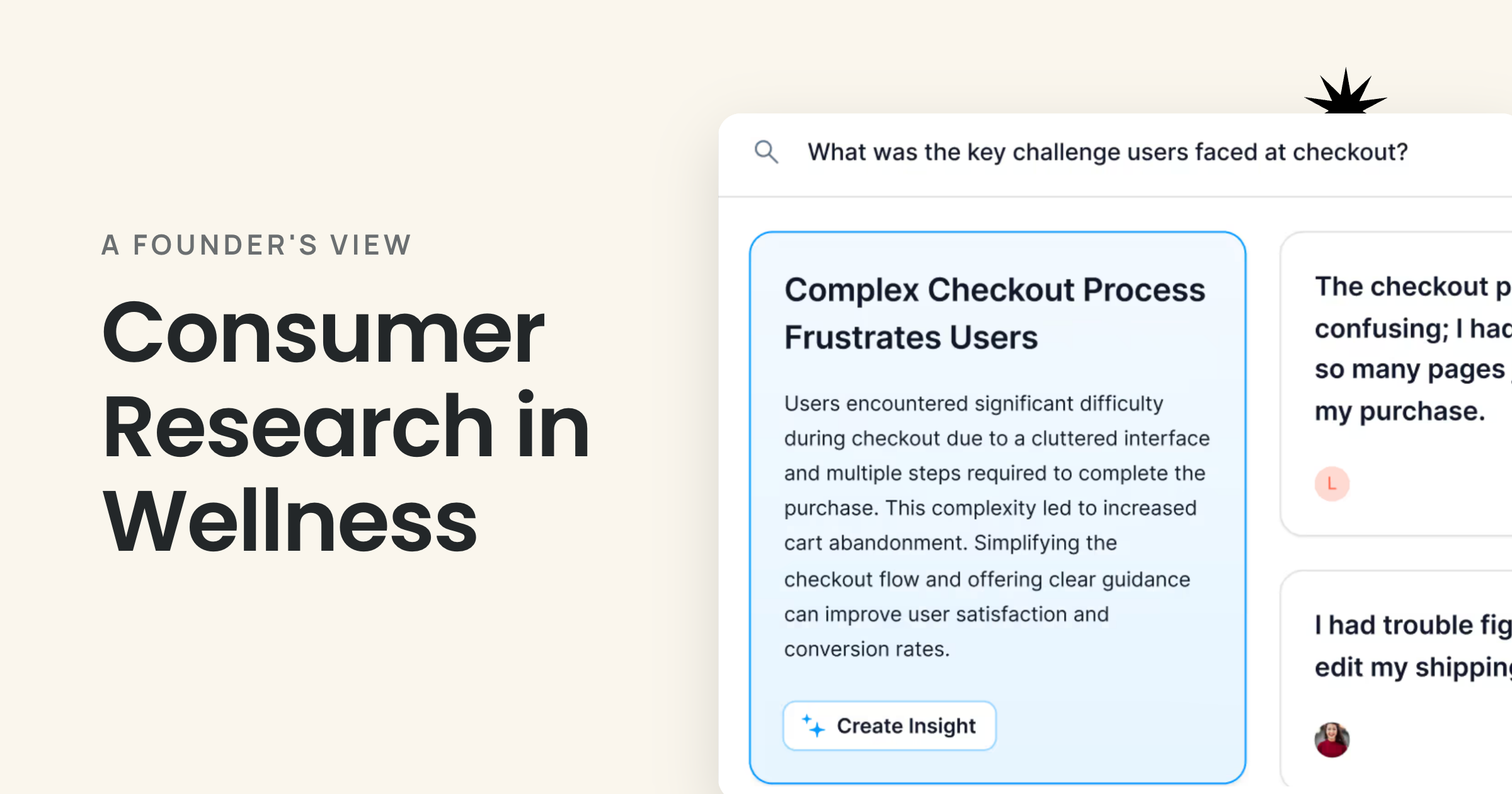
The cart was where the most friction surfaced. Once subscription was no longer required, the team had to find new places inside the cart to explain and upsell it. The first prototype ended up cluttered with buttons and entry points that made it hard to tell what was happening, where to subscribe, or what the subscription benefit actually was.
A Strella usability test surfaced the confusion almost immediately.
The fix came from the same study. Customers told the team they didn't fully understand what they were subscribing to, so the team added a Subscribe and Save modal at the cart's subscription entry points. The page explained the benefits, letting customers choose their delivery cadence, and removed the barriers that had kept people from converting. Those changes shipped before the rebuild went live, instead of after a customer-support backlog forced the issue.
Act 3 — Design: "Build Your Own Box"
The third study brought research up against one of the harder tensions in DTC: brand instinct vs. usability. As part of the reinvention, the team had built an entirely new "build your own box" flow, a choose-your-own-adventure experience that let customers compose an order from scratch. The first prototype was visually striking with big product photography, bold colors, the kind of design that looks great on a screen.
But it wasn't usable. The components were oversized, customers had to scroll endlessly, and the copy went unread. When the team put the prototype in front of customers through Strella, the friction came back fast and pointed in the same direction.
The team went back to product-design fundamentals. They moved to a structural grid layout that UX customers already know how to navigate and shipped the more conventional design instead of the more beautiful one. The research kept the team honest at exactly the moment brand instinct was pulling away from what worked.
Inside the Workflow
Trusting the AI Moderator
Before any of this could work, the team had to get comfortable with one of the harder asks of AI-moderated research: handing the conversation over. For Daily Harvest, that meant letting Strella interview their existing customers directly, without anyone from the team in the room. The early concern was the obvious one: would the AI ask the wrong questions, miss important follow-ups, or drift off topic?
Those doubts faded once the team started reviewing the recordings. The follow-up questions were the ones a thoughtful human researcher would have asked. The conversations stayed on topic. The interview quality held up.
Something the team didn't expect surfaced too: customers were often more candid with the AI moderator than they would have been with a person. Without a human interviewer in the room, participants were casual, chatty, and willing to share details they likely would have softened otherwise.
From Interview to Highlight Reel
Turning interview footage into a shareable highlight reel used to be a project of its own. In a traditional research workflow, an editor or a researcher had to scrub through hours of video and clip moments by hand, work most lean teams skip because they can't afford it.
In Strella, it's a one-click operation. The platform surfaces relevant moments based on the study's objectives, and clips can be saved straight to a reel and dropped into an executive deck. Highlight reels stopped being a luxury at Daily Harvest and became part of how the team shares insights internally.
The Results
The reinvention launched on the back of validated decisions, not guesses. A few patterns stand out from how research changed the way Daily Harvest operates.
Speed to Insight
Studies that would have taken a month — recruiting, scheduling, moderating, synthesizing — now happen in days. The team kicked off their first concept test in early August 2025 and was building product within a month. The barrier to research, as Jackson put it, is no longer time.
Research Without a Research Team
Daily Harvest didn't have an in-house researcher for this reinvention. With Strella, that hasn't stopped them from getting research done. Marketing, customer service, digital product, and engineering can each draft their own prompts and call guides and run their own studies. The teams closest to the questions can now run the studies themselves.
Synthesis Anyone Can Use
The single feature Jackson points to most often isn't on the recruiting or moderating side, it's what happens after the interviews are done. Strella's chat lets the team query the entire body of responses directly, the same way they would prompt a general-purpose AI assistant.
De-Risking the Riskiest Decisions
The clearest impact isn't on the small calls but the big ones. New verticals, new funnels, new product formats, new pricing: each can now be tested with real customers before the team commits real money to building them. That's the difference, in Jackson's framing, between flying blind and making informed bets.
From Problem Child to Embedded Practice
Research used to be the problem child of the product process, a necessary evil, and the first line item to get cut when timelines tightened. At Daily Harvest, that's changed. Studies kick off in an afternoon, insights come back in days, and the people running them don't need to be researchers.
The clearest sign of the shift isn't a number. It's where research now lives inside the company.
Daily Harvest's reinvention isn't finished. The team is already lining up the next set of studies: loyalty program comprehension, new product formats, ongoing pricing tests. Each study widens the loop a little further.
The team no longer has to choose between speed and validation. They get both, and the business gets to make bigger bets with smaller risks.
If your team has big decisions to make but not enough research capacity to validate them, Strella was built for you. Schedule a demo or email us at hello@strella.io to learn more.