What Is an AI-Moderated Interview?
Learn how AI-moderated interviews work, how they compare to human moderators and surveys, and when to use them for consumer research.

The leadership team wants to know why lapsed subscribers in three markets stopped buying, and they want the answer before the Q3 planning meeting. Answering that question well means putting the customer’s own voice in the room.
A survey is fast, but it tells the team what happened, not why. In-depth interviews explain why, and running them through an agency takes about five weeks to recruit, interview and analyze. AI-moderated interviews are a new methodology that sits between the two. An AI moderator asks follow-up questions on what each real person says, so the study has the depth of an interview while running at the scale and speed of a survey.
What is an AI-moderated interview?
An AI-moderated interview is a qualitative research method in which an AI moderator holds a voice-to-voice conversation with a participant, follows the researcher’s discussion guide and asks follow-up questions based on what that person says. On the Strella Platform, AI-moderated interviews run with real people at scale and deliver decision-ready insights in hours, not weeks.
The platform handles four stages of a study, while the researcher sets the objectives, decides who to recruit and interprets the findings.
- Study guide creation: Researchers write the discussion guide themselves or draft it with the AI guide builder in the Strella Platform, then edit every line.
- Participant recruitment: Teams invite their own customers by direct link or draw from integrated panels and expert networks. Each session starts when the participant clicks, with no scheduling step.
- Moderation and dynamic follow-up: The AI moderator grounds each follow-up question in what the participant just said and in the context the researcher provides, such as objectives and background. Unlike a survey or a scripted chatbot, it does this across hundreds of participants at once.
- Analysis as interviews finish: The output goes beyond transcripts to themes and quotes linked back to the original sessions, plus fully customizable reports that research and insights teams use to share findings.
How does an AI-moderated interview work?
A study on the Strella Platform moves through five steps, and the researcher owns the decisions at each one:
- Design the discussion guide from research objectives.
- Recruit and screen participants.
- Run the interviews with the AI moderator, which probes in real time.
- Synthesize the results into themes, verbatims and highlight reels, then query them.
- Share findings with the team and iterate.
Step 1: Design the discussion guide
A researcher starts by typing the decision the business needs to make (which of three pack designs to launch, why trial buyers churn after month two), and the Strella Platform drafts a discussion guide with sections, open questions, and tasks such as ranking, rating and branching. A bias check flags leading or loaded questions before launch. Researchers can drop stimulus directly into the guide: a Figma prototype, a live website, images, video, ad copy or survey-style questions, so the moderator shows a participant the concept and asks about it.
Researchers can edit every line, and the guide is also where they set probing instructions: whether the moderator should probe on a given question, how much to probe, and what to probe on.
Step 2: Recruit and screen participants
Participants arrive by one of two routes. Researchers send a direct link to their own customers, or they draw from the integrated panels and expert networks inside the platform. Either way, studies run in more than 40 languages and across countries, so the same guide goes out in Madrid and Mexico City on the same night.
Researchers write the screener questions for each study, with criteria such as which brands a participant buys and how recently they bought in the category, or role and company size for a B2B study. Participants whose answers meet the criteria qualify; those whose answers do not are screened out. Researchers also set quotas on the audience mix, and the platform fills against them. Qualified participants go straight to the interview, because a session starts when the participant clicks.
A screener alone does not stop fraud, so Strella layers its own controls on top of panel-provider screening:
- Screener fact-checking: The platform checks screener claims and automatically drops participants whose claims do not hold up.
- Post-call review: Automated checks cover completion, response quality, consistency, location, IP and timing, plus human review.
Before the first session, researchers add the consent and recording disclosure to the opening of the guide. Every participant hears both before the interview starts.
Step 3: Run the interviews with the AI moderator
The AI moderator holds a live, voice-to-voice conversation with a real participant, listening to each answer and, following the probing instructions set in the guide, deciding whether to probe or move on. Every session is recorded with audio, and sessions can also include video and screen recording, on desktop or mobile.
On a supplement concept test, adaptive probing runs like this:
Moderator: You said you’d probably keep taking your current one. What would make you switch? Participant: The price. This one’s more. Moderator: You mentioned price first. When you compare, are you looking at cost per month or cost per serving? Participant: Per month, I guess. I don’t do the math. Moderator: So it’s the number on the checkout page that matters. Has a monthly price ever made you cancel something you otherwise liked?
None of those follow-ups appear in the guide. The moderator generated them from the participant’s words plus the context and guidance the researcher gave Strella in the guide. Chopra and Haaland found that the value of AI-led interviews comes from the dynamic follow-up questions, not the opening answers (SSRN). The follow-up questions are where the moderator finds the why. Try an AI-moderated interview to hear how the follow-up questions adapt to your answers.
Step 4: Synthesize and query the results
Results synthesize as interviews finish. The team sees:
- Transcripts for every session
- Themes organized by question and by objective, with auto-coded open-ended responses
- Verbatim quotes, each linked to the source interview
- Video highlight reels assembled by theme
- A chat interface that answers questions about one session or the whole repository with source-linked video clips and charts
The repository also accepts uploaded historical interviews, customer calls and documents. When a researcher asks what customers say about packaging, the answer draws on last year’s agency transcripts alongside this week’s study. Every synthesized insight traces to the recording it came from, so a researcher can check any finding against what the participant said.
Step 5: Share findings with the team and iterate
Researchers and insights teams share findings through fully customizable reports, highlight reels and source-linked quotes. Teammates can see and hear the participants behind each finding, and research becomes a continuous practice instead of a one-off project. Teams can now continuously access their customers, so the next question, such as a follow-up on the lapsed-subscriber findings or a pricing check next quarter, goes back to customers without starting from scratch, and each study adds to the research repository that teams query alongside new studies.
What does the Strella Platform do?
The platform covers each stage of a study, from design through findings.
- Study design: An editable discussion guide, drafted with the AI guide builder, with questions, tasks, branching, randomization, stimuli and a bias check.
- Recruitment: The team’s own customers by direct link, integrated panels or expert networks, with screeners, quotas, screener fact-checking and post-call fraud review.
- AI-moderated interviews: Voice-to-voice conversations with real people, hundreds in parallel across time zones, 24 hours a day, so a study launched at 5pm in New York has finished interviews from Tokyo by morning.
- Human and hybrid moderation: Teams choose AI, human or hybrid moderation for each study, and all sessions share one repository.
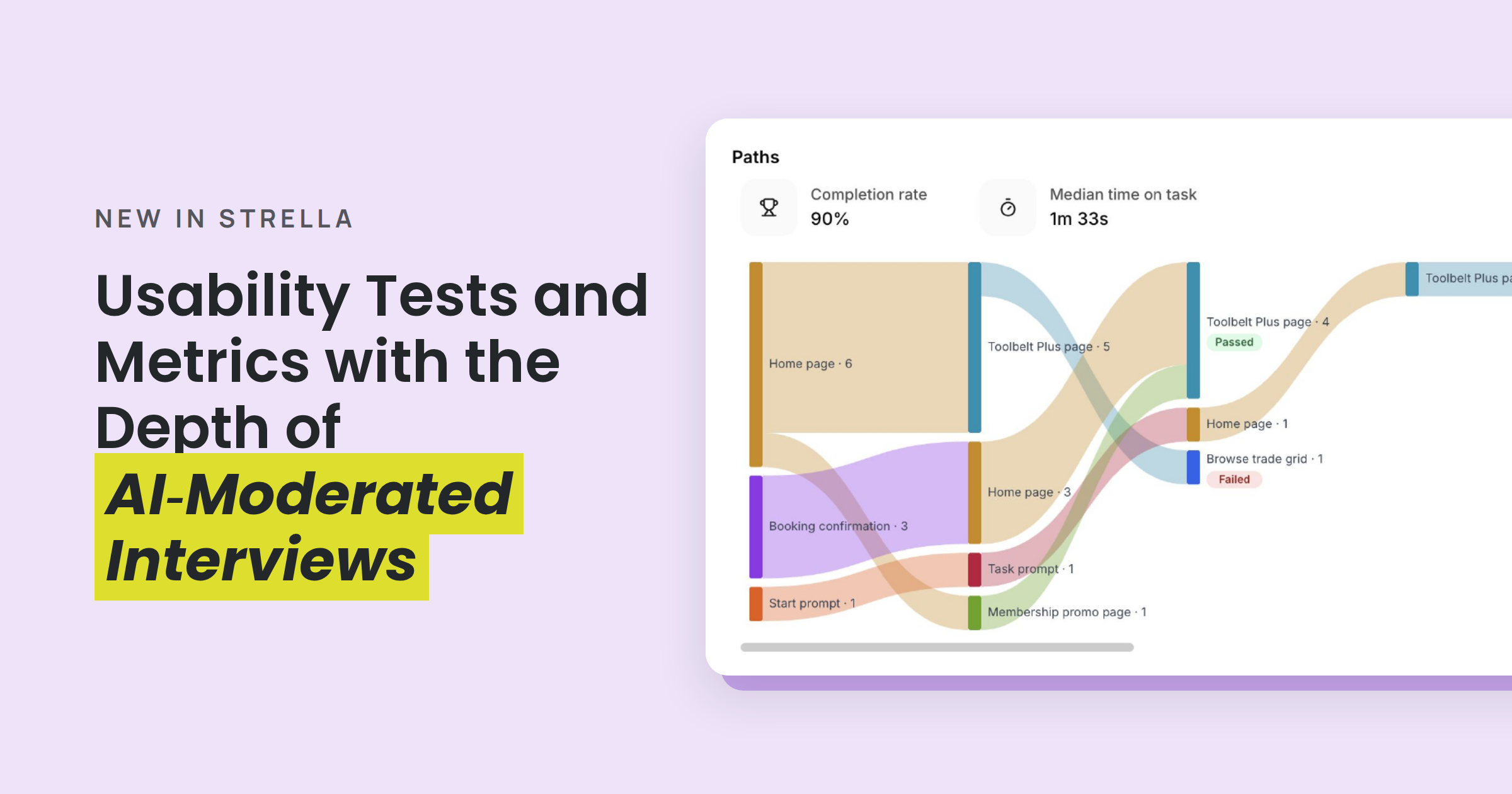
- Stimulus testing: Figma prototypes, live websites, images, videos, ad copy and survey questions, with mobile screen sharing, heatmaps and task-level analytics.
- Synthesis: Themes by question and objective, auto-coded open-ended responses, source-linked verbatim quotes, charts, video highlight reels and customizable reports.
- Research repository and chat: Past interviews, customer calls and research documents, uploaded and queried alongside new studies through a chat interface that returns source-linked answers.
- Claude and ChatGPT connector: Current customers can create studies, search transcripts, analyze results and pull quotes from inside Claude or ChatGPT. Strella also works with Cursor, Figma Make and Notion and offers a REST API.
- Languages: More than 40.
- Strella Advisory: A done-for-you option in which Strella’s research team scopes, recruits, moderates and synthesizes the work.
What do participants experience?
A participant opens a link on a laptop or phone, and the conversation starts when they click. There is no time to book and no scheduling pressure. The experience is relaxed and conversational, and participants talk at their own pace and in their own words. The opening of the guide tells them the session is recorded and that they are talking to an AI moderator, as the ICC/ESOMAR Code requires.
Strella asked 50 participants what it was like to talk to an AI moderator. Their answers cover the experience in their own words. Where the emotional experience of talking to a person matters to a study, human-moderated interviews on Strella are the right choice.
How does an AI moderator compare with a human moderator and a survey?
AI moderation is a new methodology that sits between a survey and a human-moderated interview, and it replaces neither. It brings adaptive follow-up questions to work that runs at survey scale. A skilled human moderator brings the rapport and judgment that make the deepest interviews, which is why human moderation remains the right choice for certain kinds of work. The table below compares the three.
Focus groups are the other format research teams often weigh. A focus group puts six to eight people in one room, where dominant voices shape what quieter participants say. One-on-one AI sessions hear each person separately, in every market, without a facility. A group still makes sense when a team wants to watch participants react to each other’s ideas.
What do insights teams use AI-moderated interviews for?
Insights teams and researchers reach for AI-moderated interviews when the question is open, the population is reachable and the answer is needed this week. Common uses include:
- Discovery research: Researchers find out why lapsed customers left, or hear a category’s language before they write positioning.
- Concept, packaging and message testing: Teams show three pack designs or two campaign scripts and hear the reasoning behind the ranking.
- Usability testing: Participants work through a prototype or live site with screen share, on desktop or mobile.
- Market exploration: The same guide runs in five languages overnight, and the transcripts compare directly.
- Win-loss: Teams interview buyers and lost prospects within days of the decision.
- Groundwork for a later survey: Interviews surface the themes and customer language worth digging into. A researcher then decides which themes earn a survey question.
- Low-incidence and hard-to-schedule audiences: Expert networks inside the platform make it practical to recruit eight CFOs at mid-market grocers, and because a session starts the moment the participant clicks, at any hour, busy experts do not need a calendar slot.
- Some sensitive topics: Participants often say they feel less judged talking to an AI moderator, with no one across the table, so they open up. Fifty participants described that experience in Strella’s own interviews.
Human moderation is the right choice for high-stakes, sensitive or culturally loaded work. Karen Lynch wrote on GreenBook in February 2026 that she “wouldn’t delegate to AI any project with high stakes, sensitivity, or cultural meaning,” including “research involving vulnerability, trauma, or DEI initiatives” (GreenBook). Strella’s human-moderated interviews cover that work.
If the question is open and participants can be reached by link, panel or expert network, start with an AI moderator; if the study involves trauma, vulnerability or deep cultural meaning, choose a human moderator.
Where does AI moderation fall short, and what do researchers do about it?
AI moderation has limits, and each one has a step researchers take to manage it.
- Calling the synthesis finished too early: The theme list can stop growing while less common ideas are still surfacing, so researchers read the minority themes themselves.
- Counting words instead of reading them: Frequency shows that a theme recurs, but the linked verbatims show whether it drives behavior. Researchers check the verbatims before treating a count as a finding.
- Missed emotional and cultural cues: A Quirk’s 2026 study of 34 Afro-descendant and Latine respondents found AI-moderated sessions missed culturally specific cues and produced weaker rapport (Quirk’s). Human moderation is the right choice for culturally sensitive work.
- Follow-ups that miss the point: The moderator can under-probe or follow the wrong part of an answer. Researchers tighten the probing instructions in the guide and read the transcripts.
If a finding will drive a launch or a cut, researchers read the verbatims, which are the participants’ own words, and watch the clips behind it before it goes on a slide.
How does Strella protect participant data and support consent rules?
Strella builds security and compliance into the platform. Research teams get these protections:
- SOC 2: Strella is SOC 2 compliant.
- GDPR: Strella is GDPR compliant.
- No model training on study data: Strella does not use study data, transcripts or results to train its AI.
- PII redaction and anonymization: Video blurring, voice and name anonymization, and flagging of material non-public information (MNPI) are available in the platform.
Research teams still confirm consent rules with their legal team before a study goes live:
- AI disclosure at the start: Researchers put the disclosure in the opening of the guide. It is required by:
- the ICC/ESOMAR Code (2025)
- the Insights Association Code (2025), when an AI-based avatar or chatbot could be perceived as human
- the EU AI Act, since August 2, 2026, when people interact directly with an AI system (European Commission)
- Recording disclosure: The MRS Code of Conduct requires that participants are told about recording at recruitment and at the start of data collection.
- GDPR lawful basis: Identify and document a lawful basis for recording, transcription, AI analysis and storage. Treat health data as special category data that needs a specific legal ground, such as explicit consent.
Bring your research question to us and we will talk it through. See Strella in action
FAQ
What is an AI-moderated interview, and how is it different from a survey?
An AI-moderated interview is a voice-to-voice qualitative research conversation between a real person and an AI moderator that follows the researcher’s discussion guide and asks follow-up questions based on what the participant says. A survey records what people chose. The interview asks why. It sits between a survey and a human-moderated in-depth interview, with interview depth across hundreds of sessions in parallel and themes in hours, not weeks.
How does the AI moderator decide which follow-up questions to ask?
The AI moderator follows up on what each participant says, plus the context the researcher provides. Researchers set in the guide whether to probe, how much and on what. Chopra and Haaland found that the mental models behind people’s answers consistently emerged in later responses to follow-ups rather than in top-of-mind first answers.
Where do participants come from, and how is fraud kept out?
Researchers can bring their own customers in by direct link, or draw on integrated panels and expert networks. Screener answers are fact-checked before anyone joins. After each call, checks cover completion, response quality, consistency, location, IP and timing, and a human reviews the results.
Will leadership trust findings from AI-moderated interviews?
Yes. Every finding links back to a real participant’s own words and video, which is more evidence than most research decks carry.
Do participants know they are talking to an AI, and can they talk to a person instead?
Yes. Participants are told at the start of every interview that they are talking to an AI moderator, as the ICC/ESOMAR Code requires and, since August 2, 2026, the EU AI Act does too. Where talking to a person matters for a participant or a topic, Strella’s human-moderated interviews are the right choice.
When should a team use a human moderator instead of an AI?
A human moderator is the right choice when the topic involves trauma, vulnerability, crisis or deep cultural meaning, or when the emotional experience of talking to a person matters to the study. Strella’s human-moderated interviews cover that work. AI moderation fits open questions at scale, including hard-to-schedule expert audiences and groundwork for a later survey.