AI-Moderated vs. Unmoderated Research: The Participant Take
We asked research participants how they prefer to answer questions: surveys, in depth interviews or AI moderation. Their responses gave us a new view on how AI moderation adds more depth.

AI-Moderated vs. Unmoderated Research: What Participants Actually Prefer
Every researcher who has run an open-ended survey knows the feeling. A participant writes something genuinely interesting in a comment box and then the form moves on. The one follow-up that would have turned a vague answer into a real insight never gets asked, because there's no one there to ask it.
That's the quiet tax of unmoderated research.
The trade-off we've all accepted
Unmoderated methods such as surveys, open-text forms and unmoderated tests, are faster and reach a lot of people. Moderated interviews go deep, but they're slow to schedule and hard to run at volume. So most research roadmaps have been shaped by a forced choice: depth or scale, pick one.
AI-moderated interviews change that math by adding depth to surveys and unmoderated tests. because they hold a real conversation with every participant and run those conversations in parallel. To find out whether that actually matters to the people answering the questions, we asked them.
What participants told us
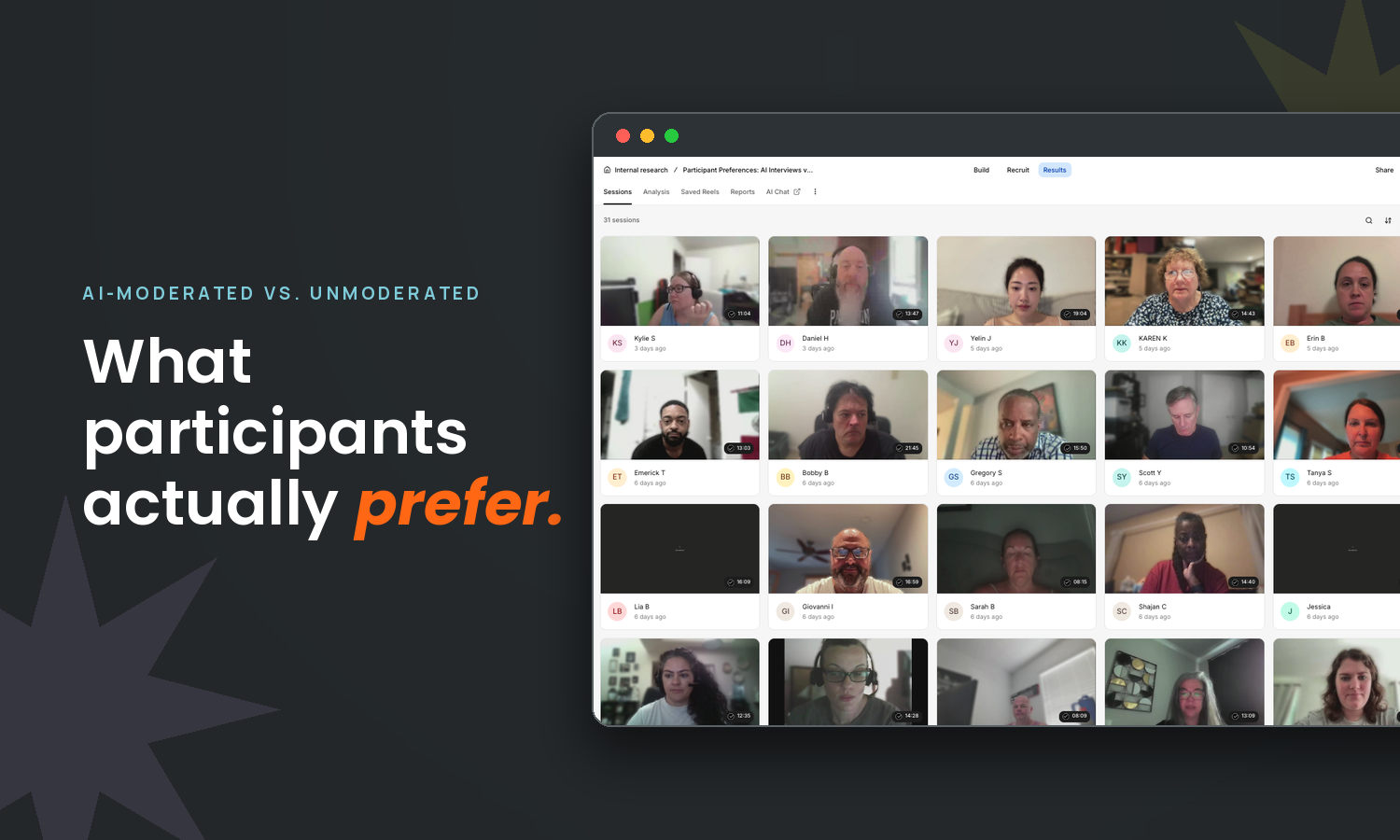
We ran a June 2026 study with 31 people who had recently taken part in both AI-moderated interviews and open-ended surveys, and asked them to compare the two in their own words. The numbers were one-sided:
- Only 5 of 31 picked surveys as their favorite format. Surveys finished last.
- AI-moderated interviews tied with traditional human-moderated interviews for the top spot.
- 21 of 31 said they would be very likely to recommend the AI-moderated experience to a colleague, scoring it a 9 or 10 out of 10.
- 0 participants rated it below the midpoint of the scale.
But the numbers aren't the interesting part. The reasons are.
Why talking beats typing
The theme participants returned to again and again was the follow-up — the thing a static form structurally cannot do.
Surveys can't prompt people for follow-ups. You have to trust that your participant is going to give you a comprehensive answer to a question, and you can't follow up with them to ask about little aspects of their answer that might shed some more light on the topic.
A survey takes whatever you give it and moves on. An AI moderator hears an interesting answer and asks "why?" — the same instinct a good human interviewer has, applied to every session at once.
The second theme: people simply say more out loud than they'll type. Several described remembering things mid-sentence that a form would never have surfaced. One participant said "By talking out loud, I remembered other things that were relevant to the topic," while another confirmed "You could say a lot more in an AI interview than you can type, without a doubt."
Typing, by contrast, is work and participants ration it. One described hitting a character limit and giving up: "I was actually getting close to the character count limit so I just it all out and gave a shorter answer to stop wasting my time"
That sentence should worry anyone relying on open-text survey data. The shallow answer isn't what the participant thought. It's what they had the patience to type.
There was an emotional dimension, too. Participants said tone and conviction come through when they talk and, notably, that they felt less judged speaking to an AI moderator than they'd expected, which made them more candid. As one put it, a survey "is just something you're reading and you're responding to... there's no life to it."
The honest case for surveys
None of this means unmoderated research is obsolete. Participants were just as clear about where surveys win, and researchers should be too.
Surveys are faster and self-paced.
you can do them in spare minutes, on your own schedule. They scale to thousands in a way interviews still don't: as one participant noted, "surveys have broader reach."
For sensitive subjects, the distance of a form is a feature.
One participant said flatly that on a charged political topic, "I would not speak that out loud. I would rather type it."
So the rule of thumb is less about which method is "better" and more about what the question needs. If you want a quick pulse, a clean metric, broad reach, or anonymity on a delicate topic, unmoderated is often the right call.
Where AI moderation lands
The reason AI-moderated interviews keep beating surveys in studies like this one is that they collapse the old trade-off. You get the adaptivity, depth, and feeling-heard of a conversation at something much closer to the scale and speed of a survey.
That makes the real question simpler than "moderated or unmoderated." It's:
Do I need to understand the why?
If a static form would leave you guessing about what a participant meant, wishing you could ask one more question, that's exactly where an unmoderated survey costs you, and where a conversation, run at scale, earns its place.
The follow-up you never got to ask is the insight you never got to have.
Findings from a June 2026 Strella study of 31 research participants comparing AI-moderated interviews, surveys, and human-moderated interviews. Participant quotes are verbatim; names withheld.