Going Deeper on How to AI UXR: the Map and the Podcast Series
We partnered with Kate Towsey to develop the How to AI UXR map, a framework for integrating AI across research operations. Now the series features an 8-part podcast where research leaders share what they're learning as they build AI-augmented practices.

How to AI UXR Map - Here's What We’ve Learned
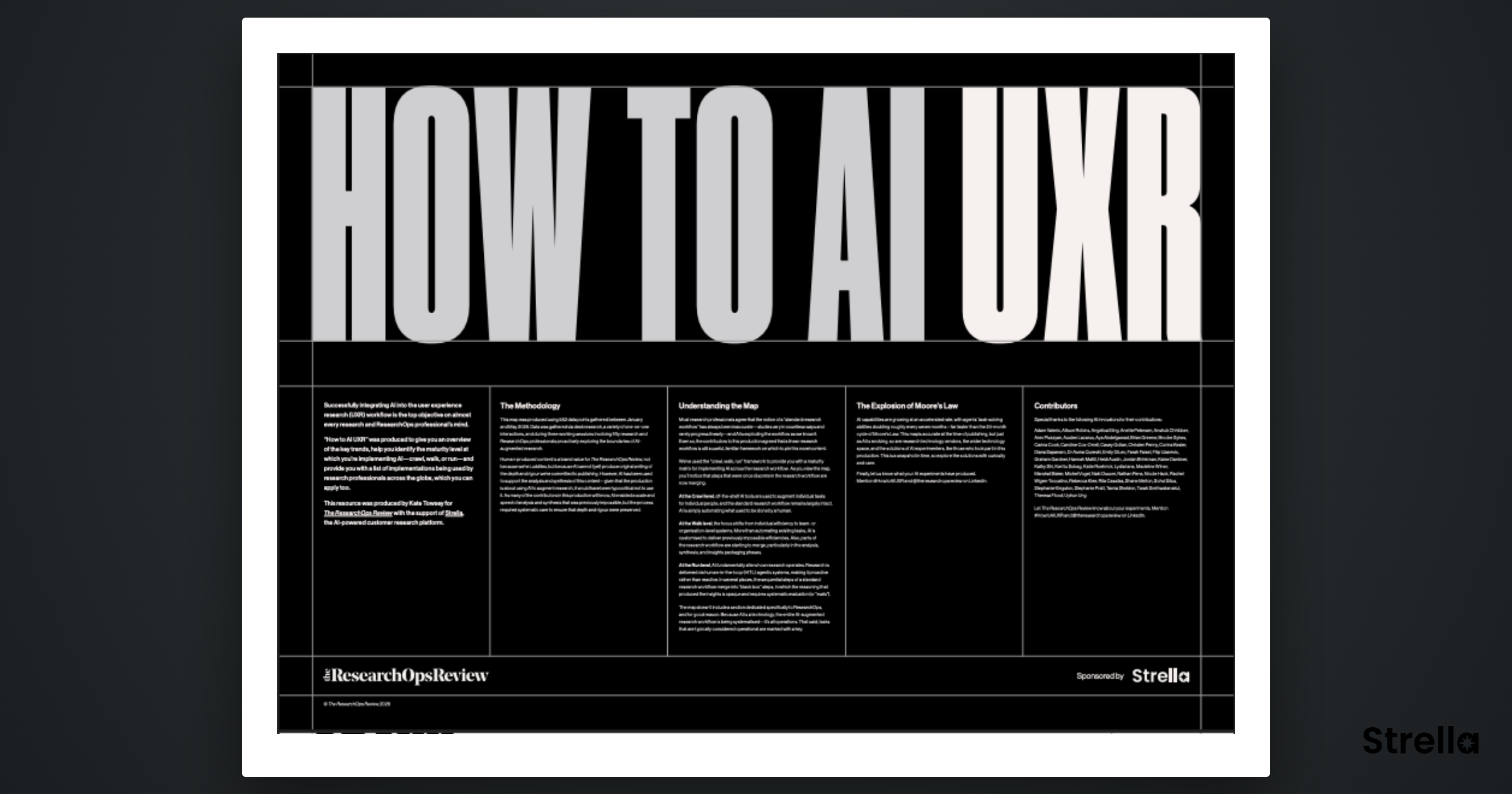
Over the past five months, we've been honored to be in the room with Kate Towsey at The ResearchOps Review as she developed How to AI UXR, a comprehensive map for building AI-augmented research operations. It wasn't a side project or a thought piece. It was built on 562 data points, conversations with 50+ research and ResearchOps professionals, and insights from researchers and teams experimenting with AI at scale.
We sponsored the work because it reflects what we're seeing at Strella every day: AI in research isn't about automation hype. It's about creating the ability for researchers to provide more quality insights and research to their teams.
The Core Insight: The Crawl, Walk, Run Framework
Most conversations about AI in research start and end with "Should we use it?" The map reframes this entirely. The real question is threefold: When does AI make sense? How do you build the operational infrastructure? And what risks do you need to manage?
That's why the map uses a maturity framework ‘Crawl, Walk, Run’ instead of a binary yes/no.
At Crawl, teams use off-the-shelf LLMs to augment tasks (drafting, summarizing, clustering).
At Walk, teams build custom systems (agents, RAG repositories, evals).
At Run, multi-agent pipelines reshape the entire research practice.
What we found: teams need to be obsessing over speed and efficiency, but also rigor. The map calls this out explicitly. With Strella, when you're running 100 AI-moderated interviews per week, you need to know that the tool has systematic evaluation and guardrails built into the process. Otherwise, you're optimizing for volume at the expense of trustworthiness.
Why This Work is Important
Strella exists to help researchers run more qualitative research. But running more research only matters if the research is good and can be used efficiently. For Researchers, this means they need a new operational discipline for developing, evaluating and using research. For AI research tools, there are new requirements and guarantees that are becoming table stakes:
- Participant quality. AI makes recruitment faster but if your screeners and fraud checks are poor, your data quality is poor, faster.
- Validated, compounding, accessible findings. When AI handles moderation, you need to know why the findings are reliable and track the source for findings. Insights must track back to real interviews, real quotes and be able to be compounded and accessed wherever researchers work.
- Human in the loop capabilities. There's a difference between "use AI for everything" and "use AI as infrastructure for better research." The first one fails. The second one works. Research is a craft and the tools you use need to treat it that way.
The map helped us clarify our own strategy: Strella's mission is to empower researchers not just to run more qualitative research more efficiently, but to empower them to run research they couldn’t have run before whether in-the-moment churn interviews or 3am user interviews.
Hear from Leaders Already Doing This
The map is a framework, but the real learning comes from watching teams actually implement it. Starting July 9, an 8-part podcast series around #HowtoAIUXR will released with new episodes dropping weekly.
Kate sits down with cutting edge research leaders from companies like Ramp, Microsoft, DoorDash and more who are already implementing AI tools and systems in their research process, navigating the tradeoffs, building the systems, managing the risks. Each episode is a conversation is a deep dive with a research leader on one aspect of their research practice and how and why are using AI, what they got wrong, and what surprised them.
Priya Krishnan, co-founder and COO of Strella, also shares her take on the conversation as a leader building one of the tools that these researchers are exploring and using.
We'll be sharing more about each episode and the guests as they drop.
Download and Experiment
The How to AI UXR map includes three levels of maturity, detailed implementations across every stage of the research workflow, and a glossary of terms you'll actually need. Download it, annotate it, experiment with it.
What we hope you take from it: AI in research isn't a product decision. It's an operational one. Get the operations right, and the tools, including Strella, work better.