Verbatim, Issue 01: A Map for AI in Research
Crawl, walk, run: a map to guide your AI research journey, why AI moderation is a new research methodology, Daily Harvest's DTC reinvention, and June product updates.

I figured I’d start off with an introduction. I'm Melissa, and I lead marketing at Strella. Before this, I spent years in the CPG world and was most recently Director of Strategy and Operations at a little olive oil company called Graza. I also happened to be a Strella customer, so I've lived the exact tension a lot of you are in: needing real customer understanding, fast, without cutting the corners that make research worth trusting.
We're calling this newsletter Verbatim, exactly what we're hearing. Once a month we'll share what we're learning about research in the AI era, plus the outside resources and customer work worth your time. First up, a question we keep hearing from research, product and insights teams: Where does AI fit in the research workflow? Before I tell you how we think about it, I want to point you to a map of the landscape made by a research operations expert.
A Resource: How to AI UXR
For a clear picture of where AI fits in research, start here. We sponsored a project led by Kate Towsey, founder of the ResearchOps Community and author of Research That Scales, through her publication The ResearchOps Review. Working with research professionals around the world, Kate built the How to AI UXR Map: a practical, vendor-neutral guide to where research professionals are already using, or would like to use, AI in their workflow.
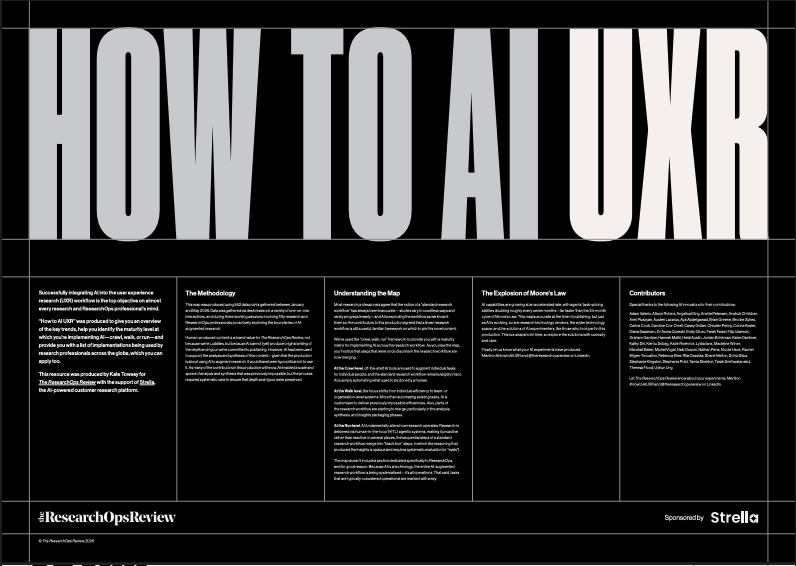
It maps AI adoption across three maturity levels, Crawl, Walk, and Run, so you can find where your team is today and see concretely what the next step looks like. It is honest about the upsides and just as honest about the risks, from shallow insights to synthetic data loops.
If you manage a research stack and you have been asked to "figure out AI" with no framework to lean on, this is the clearest starting point I have seen. Here are some resources from Kate and the ResearchOps Review:
- How to AI UXR: A Map for Building AI-Augmented Research Operations (start here, the map is a free PDF download)
- A Wake-Up Call for ResearchOps on why "I-Me-Mine AI" isn't enough
- Research That Scales: The Research Operations Handbook, Kate's book on building research that grows with your org
Plus, stay tuned for eight podcasts on #HowtoAIUXR with Kate alongside ResearchOps leaders, dropping weekly starting July 9th.
Our take: AI moderation is a new methodology
While Kate was busy mapping the entire research universe, the Strella team has been heads-down on one question within it: how and where AI moderation fits.
Most people make a mistake when they first learn about AI moderated interviews; they think of them as human moderated in depth interviews (IDIs), without the human. It’s actually the other direction, AI moderated interviews are much closer to an unmoderated test or a survey with a lot more depth.
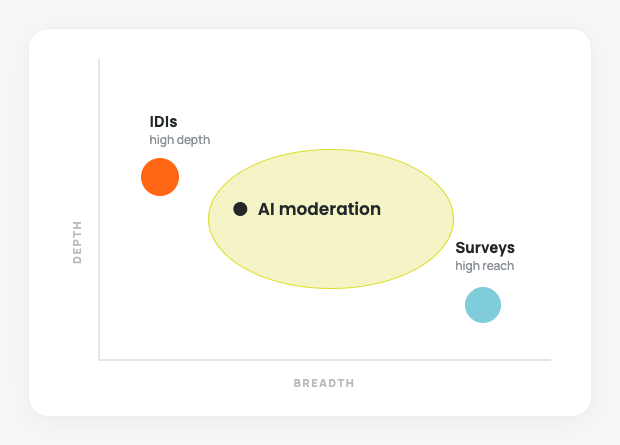
A survey gives you scale, consistency and reach but not the "why" or “because.” AI moderation sits in the gap between unmoderated and moderated, as a survey that can ask a follow-up or an unmoderated test that notices when someone contradicts themselves and digs in.
You're trading up from a static instrument, and getting qualitative richness at a scale that was never possible before. Once you shift the perspective you start to unlock research you didn’t think was possible such as:
- Always on qualitative studies that keep a constant pulse on your customers
- Multi-lingual studies conducted across continents all at the same time
- Hard to reach audiences that are willing to talk if you can interview at any time of the day or night
The honest caveat, and one we say often: speed without guardrails is just faster bad research. AI moderation only earns trust when it comes with clear operational standards and repeatable evaluation of quality. That is the difference between a new methodology and a shortcut. Read more on our blog.
In their words: Daily Harvest's DTC reinvention
Check out the work that our Strella Advisory team did with Daily Harvest.
In case you missed it: product updates
You can always check our changelog for week to week updates but here are a few we are particularly excited about.
Your Research Partner Upgraded
Our team was working on making all aspects of setting up, running and analyzing a study more collaborative and seamless with chat onboarding, study builder and analysis getting an upgrade.
- Chat Onboarding got a full refresh and now dynamically probes you during study creation to develop a participant screener, research objectives and study guide draft that are as close as possible to research ready.
- Study Builder picks up where chat onboarding leaves off and now appears as a right hand panel within the builder screen. It helps you review and refine existing study drafts and screeners, add stimuli, update questions or flows.
- Strella AI Chat now has more context, better tools and faster analysis, creating charts, highlight reels and reports all live in one chat plus the ability to exclude interviews from an analysis.
Plus a few API and security upgrades
- New API features that allow you to create, rename, and delete workspaces programmatically - see our full API documentation for all of the features (and don’t forget about MCP!)
- Material Non-Public Information (MNPI) flagging that alerts you if a participant shares sensitive non-public information
- Privacy update: participant names stay hidden in transcripts without the right permission
If you got all the way here, thanks for sticking around. More next month.
Talk soon,
Melissa